Electronics DIY blog

DIY is fun and is food for the brain and spirit. Don't be afraid to learn.


Showing posts with label control box. Show all posts

Tuesday, June 12, 2012

CNC Control Box - Part 2

In the previous part I showed how I arranged the electronics for the CNC stepper motors inside a nice and very practical PC case.

I'm now in the process of attaching a plug-panel to easily attach/detach the motors from the control unit.


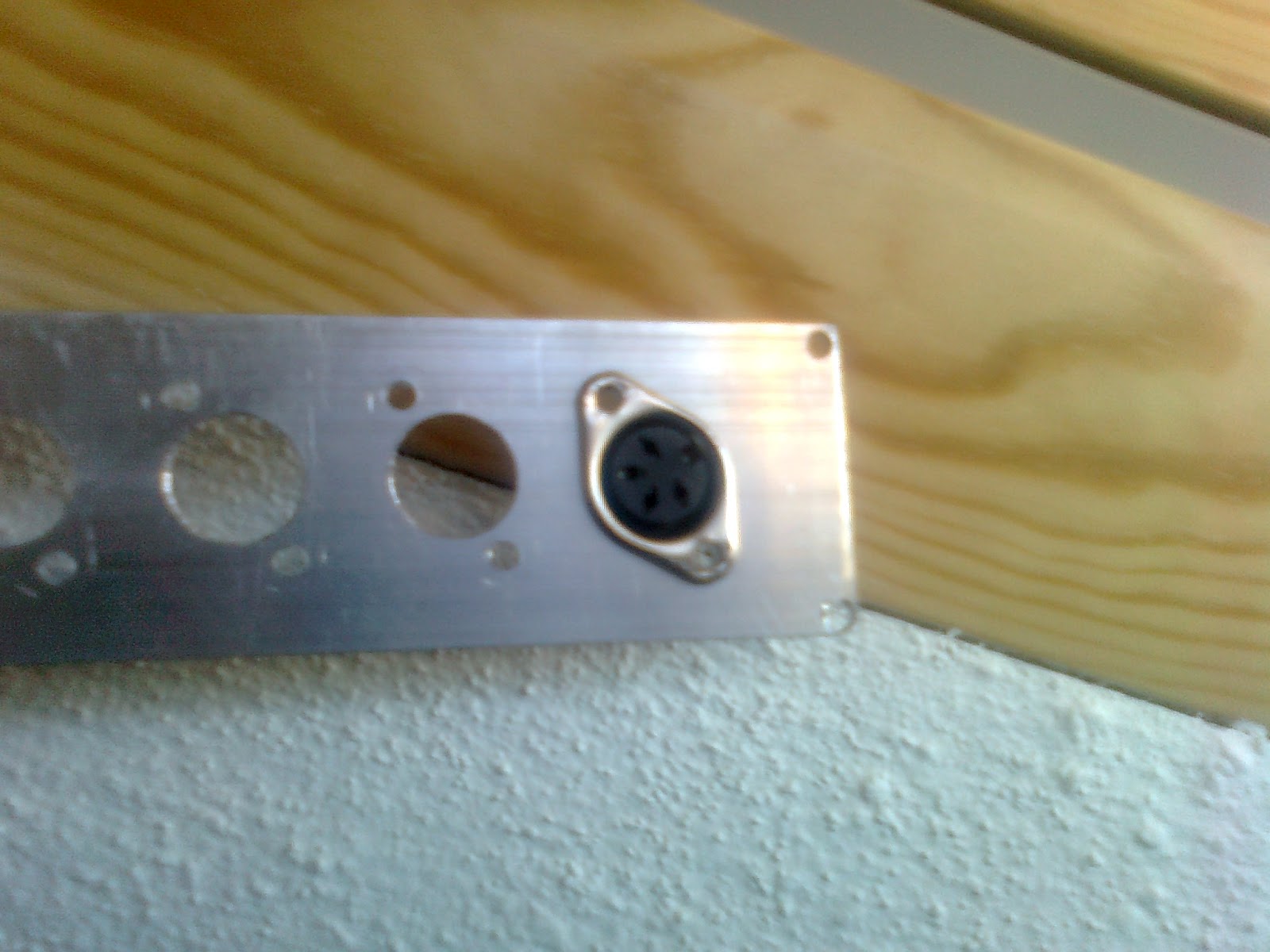
For this I’m using 4-pin DIN panel connectors.

Custom made connector front panel
4-pin DIN panel connector
For me the best spot to place the panel is right in the front of the PC case where the CD-ROM drive should be. I’m using an piece of aluminium (bought an 1000x25x2,5mm stripe of aluminium) that was cut to form the front plate that I’ve cut and drilled to fit the panel connectors.

After I riveted the aluminium plate in the case all that is left I to solder the wires and rivet the connectors to the plate, but you can get the general idea.

Check it out. ;-)


Riveted front panel
Almost finished box


Tuesday, May 15, 2012

CNC Control Box - Part 1

Control box (pre)wiring
This will be the control box for my CNC. I bought the kit from Keling Inc. on e-Bay, with the NEMA 34 steppers. The KL-4030 drivers will control the stepper motors in a 1/4 or 1/8 micro stepping configuration. It will all be housed in an old PC case.


Control box wiring final
With a resolution of 1.8 degrees per step (for an 1/8 micro stepping) will allow about 1600 pulse steps per revolution. The motors will by their hand be coupled to a RM1605 ball bearing screw. This means that every pulse the driver receives the axis will travel about 0.003125mm.

The 1/4 or 1/8 micro stepping will be determined by the amount of vibration caused by the motors.

Micro stepping trades torque for vibration and smoothness and even more important trades resolution for accuracy. Make notice I did not mentioned precision because the loss of torque can affect the ability to make the structure move and the motor can actually skid under the force of the unwilling linear motion system. And micro stepping is a real torque sucker. Check this article to see what I’m talking about.

Next will be the wiring of the steppers to the control and testing the micro stepping configuration.